Septic Tank Pumping
Routine pump outs on a schedule that fits your household size.
Learn more about Septic Tank Pumping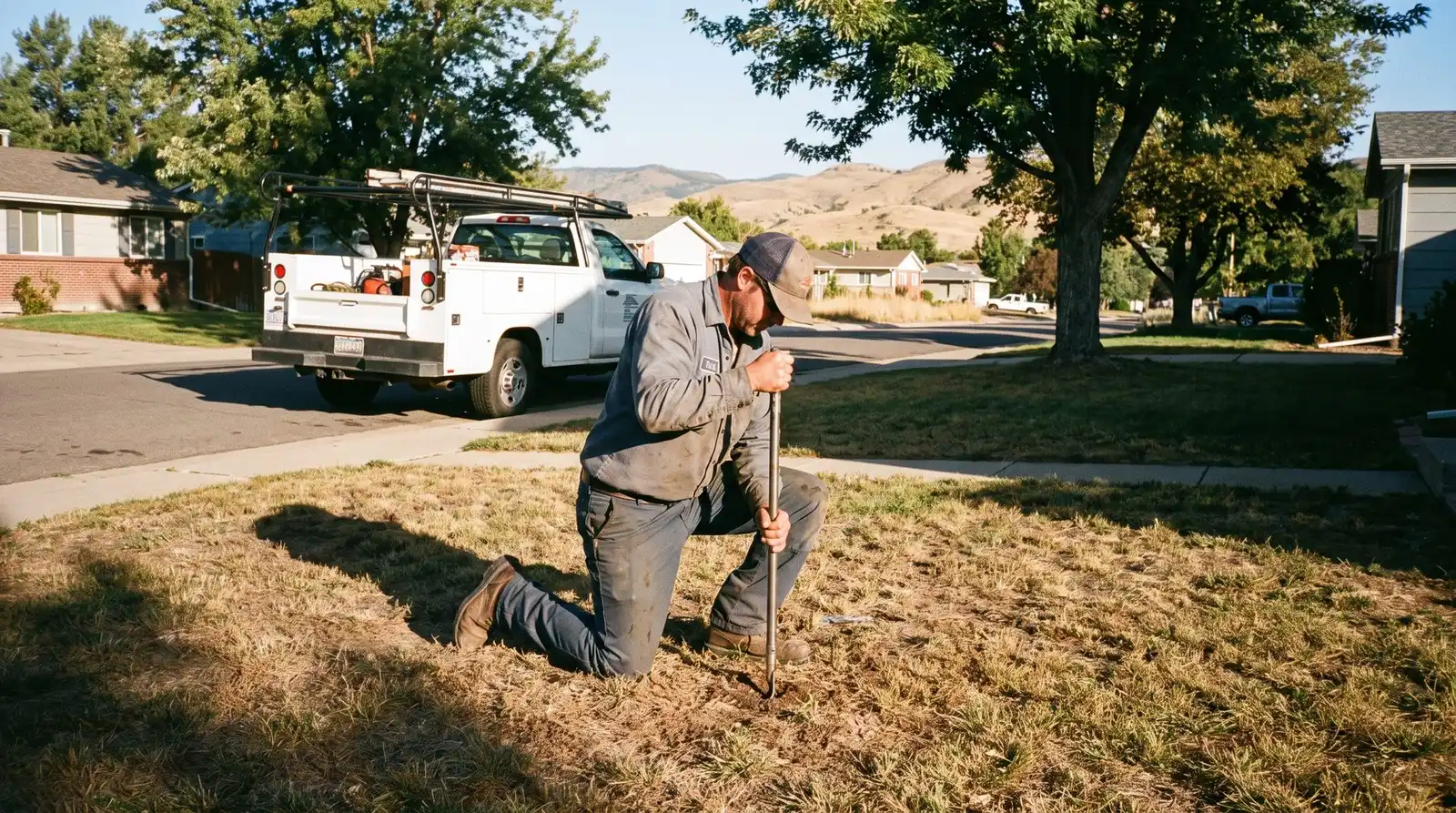
Septic locating finds a buried tank, its access lids, and the lines running to and from it. Troubleshooting traces a symptom back to the component that actually caused it. Both exist because you cannot service, inspect, or repair a system you cannot find or understand. Affordable Septic Pumping does this work across Denver and the Colorado Front Range. Call 720-427-7557.
Get Your Free Quote!
Licensing, experience, and credentials
The situation
Because it was buried and then everything above it changed. Older Front Range systems were installed with lids a foot or more below grade and no risers, and in the decades since, the yard got regraded, sod went in, a deck or a patio got built, trees grew, and the paperwork went missing between owners. None of that is unusual and none of it is your fault.
The practical problem is that nothing else can happen until the tank is found. It cannot be pumped, it cannot be inspected for a sale, and it cannot be repaired. If you are on a deadline for a closing or a county use permit, locating is the step that has to happen first, and building time for it into the schedule prevents a very expensive week.
You can often narrow it down yourself before calling. How to find a septic tank lid walks through the checks that cost nothing, and finding septic records in Colorado counties shows how to pull the original permit and as built drawing from the county.
The other half of this service is troubleshooting, which is a different problem. There the tank location is known but the cause of the symptom is not. That is where the diagnosis matters more than the digging.

How the job runs

Where a permit and as built exist, the drawing often gives distances from the house corners. This is the cheapest possible way to find a tank and it is the first thing we try.
The main drain exit point sets the direction of the run. From inside, the cleanout and the direction of the building drain point the way even when the yard gives no clue.
Settling over the tank, a rectangle of grass that greens or browns differently, a slight depression, or a bare patch through drought all mark buried structures. Snow melt patterns in winter are one of the most reliable tells on the Front Range.
A soil probe run in a grid along the expected direction finds the tank lid or the tank top. Done carefully this locates most tanks without opening a single shovel of unnecessary ground.
On properties where the run is long, has been rerouted, or crosses hardscape, we trace the line itself rather than hunting the tank blind.
Hand digging to the lids rather than machine work, because a struck lid is a repair you did not need. Both access points get exposed where the tank has two.
You get the tank and lid locations documented with measurements from fixed points on the house. This is also the right moment to install [risers and lids](/septic-tank-risers-and-lids) so the access sits at grade from now on.
Troubleshooting is elimination, and the order matters because each step rules out a whole category of cause. The liquid level in the tank is the first and most informative reading. A level above the outlet invert means effluent is not leaving the tank, which points downstream at the filter, the outlet line, the distribution box, or the field. A normal level with a symptom in the house points upstream at the inlet line.
From there we run water from the building to confirm the inlet flows, pull and check the effluent filter, evaluate the inlet and outlet baffles, and check the distribution box where the design has one. In a dosed system, the pump, float, and alarm get tested. Finally we watch the tank refill after drawdown, which is the best available read on whether the drain field is still accepting effluent.
The point of doing it in that order is that it stops you paying for the wrong repair. A homeowner who replaces a pump when the real problem is a saturated field has spent money and still has the problem.
These are the ones where the obvious answer is wrong often enough to be worth a diagnosis first.
You strike something. The usual casualties are the tank lid, the inlet or outlet line, a well line, an irrigation main, or a buried electrical run to an outbuilding. Every one of those turns a locating fee into a repair bill, and a cracked lid or a broken line means the system is now compromised on top of being unlocated.
There is a slower cost too. Machine digging over a drain field compacts the soil and can damage laterals, and drain field soil damage is the one kind that does not repair. Drain field failure signs covers what that leads to.
Guessing at the diagnosis has the same shape. Replacing a component that was not the cause leaves you with the original symptom and less budget, which is exactly the situation people are in when they call us second.
Locating finds and exposes the tank and its access. It does not include pumping, which is scheduled as its own service once the lids are open, and it does not include repairs. Troubleshooting produces a diagnosis and a recommendation rather than a formal inspection report. If you need documentation for a sale, a lender, or a county use permit, that is a septic tank inspection. Interior plumbing diagnosis inside the building is plumbing work rather than onsite wastewater work. And where hardscape, a deck, or a structure has been built directly over the tank, removing it is not part of the service, though we will tell you exactly what has to come out.
Why us
What it costs
It depends on how much information exists before we start, how large the parcel is, how deep the tank sits, what is on top of it, and whether ground conditions are workable. A tank with a county as built on a flat quarter acre is a short visit. An unrecorded tank on five acres with mature landscaping and frozen ground is not. Troubleshooting is priced on the diagnosis visit, and any repair it identifies is quoted separately. Call 720-427-7557 with the property address, the approximate age of the house, and anything you already know, and we will tell you what to expect. Our septic service cost page covers the rest of the menu.
Questions
Keep going
Routine pump outs on a schedule that fits your household size.
Learn more about Septic Tank PumpingFull system inspection for buyers, sellers, agents, and lenders.
Learn more about Septic Tank InspectionBaffles, filters, risers, lines, and drain field problems.
Learn more about Septic System RepairGuides on finding your tank, reading the symptoms, and pulling county records.
Family Owned & Operated. Call 720-427-7557 or send the form and we will get back to you with a straight answer.