Septic System Repair
Baffles, filters, risers, lines, and drain field problems.
Learn more about Septic System Repair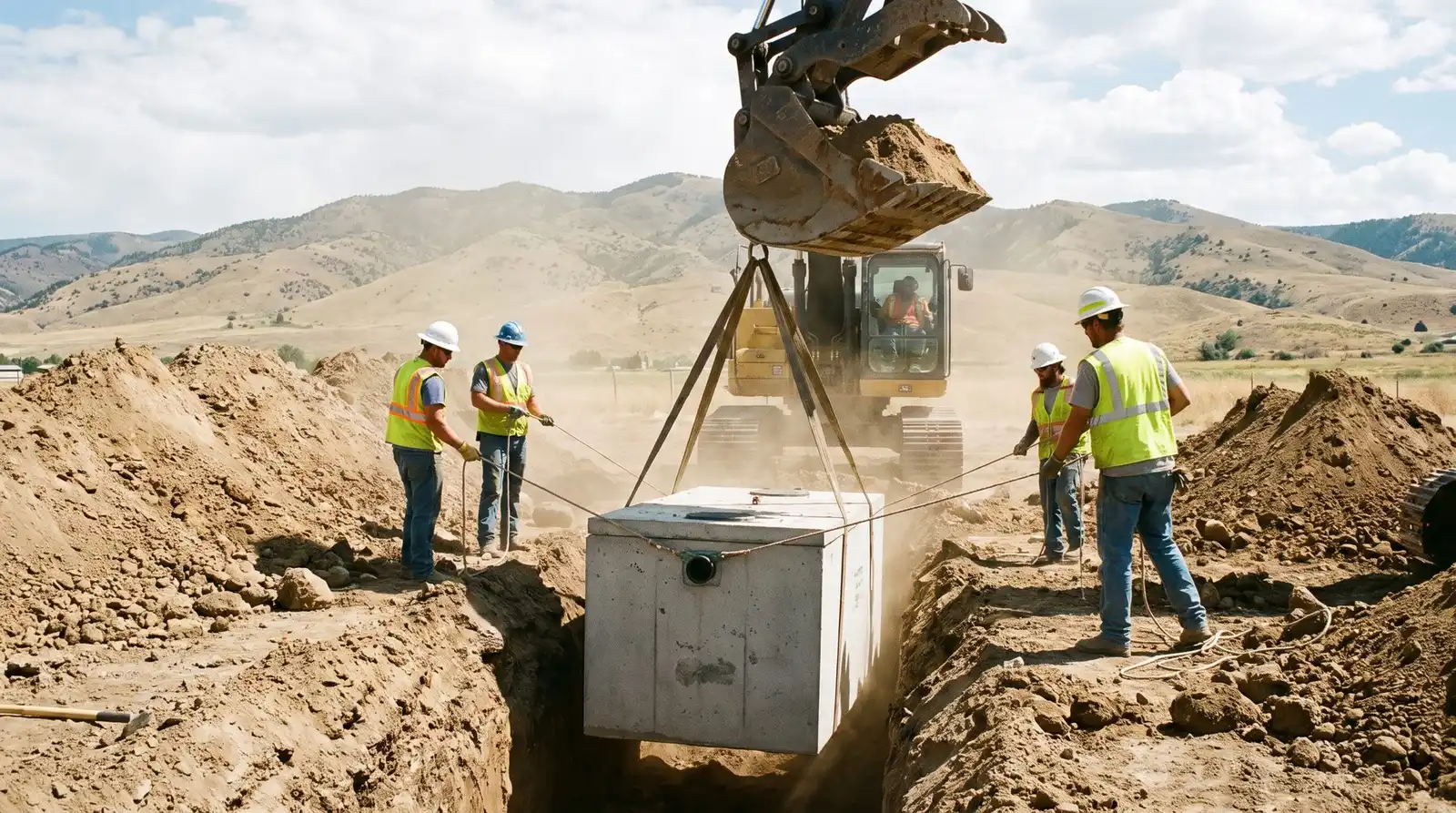
A septic installation is a permitted construction project. The soil gets evaluated, a system gets designed to match that soil and the household it serves, the county issues a permit, the tank and drain field go in, and the county inspects before anything is covered. Affordable Septic Pumping handles new installs and full replacements across Denver and the Colorado Front Range. Call 720-427-7557.
Get Your Free Quote!
Licensing, experience, and credentials
The situation
Three situations. New construction on an unsewered parcel, which is most rural and mountain land across the Front Range. A full replacement because the existing system has reached end of life. Or a system that no longer matches how the property is used, usually after an addition, a finished basement, or a change from seasonal to year round occupancy.
The replacement case is the one homeowners hate hearing about, and it almost always traces back to the drain field. When soil pore space has clogged with solids there is no repair path, and septic repair versus replacement in Colorado covers how that determination gets made. Septic system lifespan in Colorado explains why age alone is not the deciding factor.
The capacity case sneaks up on people. A system designed for a three bedroom house does not automatically serve a five bedroom house, and the county sizes by bedroom count for exactly that reason. If you are adding bedrooms, talk to us and to the county before the framing goes up.
For new construction, the new construction septic installation process walks the sequence from soil test to certificate of occupancy, and rural residential septic and mountain property septic cover the site conditions that most often complicate a Front Range install.

How the job runs

We walk the parcel, look at slope, setbacks, access for equipment, well and water body distances, and pull any existing permit or as built where a system is already in place.
Test pits and percolation testing tell us how fast the soil accepts water and how deep usable soil goes before rock or groundwater. This is the single most important input to the design and it cannot be skipped or estimated.
The soil results, the bedroom count, and the site constraints produce a design. Good soil with room supports a conventional gravity system. Poor soil, shallow bedrock, or a high water table push toward [a mound system](/mound-system), [a sand filter](/sand-filter-system), [an aerobic treatment unit](/aerobic-treatment-unit), or [a chamber system](/chamber-system).
The design goes to the county health department with the soil report. Nothing gets built until the permit is issued. Review time is set by the county, not by us.
The tank excavation is opened, the tank is set and leveled, and the inlet and outlet connections are made. Level matters here more than anything. A tank set out of level never settles into behaving correctly.
Trenches or beds are cut to the design depth, distribution piping goes in, and where the design calls for it [a distribution box](/distribution-box) or [a pump chamber](/pump-chamber-and-lift-station) is installed to move effluent where gravity will not.
The county inspects the open system. This is not optional and it is not a formality. Covering the work before inspection is how a project gets torn back open.
The system is covered, the site is graded to shed surface water away from the field, [risers and lids](/septic-tank-risers-and-lids) are brought to grade, and you get the as built along with the maintenance schedule the system needs.
Not preference and not budget. The site decides, and the county signs off. These are the inputs that actually move the design.
Excavation and construction is the short part. The schedule is dominated by soil testing, design, county permit review, and inspection availability, and those steps run on the county calendar rather than ours.
Weather matters more here than in most places. Frozen ground and heavy snow slow or stop excavation in the foothills and at altitude, and spring runoff can raise the water table enough to change what a soil test shows. Fall and late spring are generally the friendliest windows.
Permit requirements are county specific. Check Adams, Arapahoe, Douglas, Jefferson, Elbert, Weld, Clear Creek, or Park for the parcel you are working with, and confirm current requirements with the health department directly.
A failed system does not sit still. Effluent that cannot enter the soil goes somewhere, and the options are back into the house, up to the surface, or laterally through the ground. Effluent surfacing over the field is a public health issue on top of a property issue, and it can draw county attention on its own.
There is a transaction cost too. A property with a documented failed system is harder to sell, harder to finance, and in counties with use permit requirements it can stop a closing outright. Septic use permit transfer covers that exposure.
The practical cost is that the failure area grows. Continuing to load a failed field can compromise soil beyond the original footprint, which reduces where a replacement field can go on the parcel and occasionally forces a more expensive engineered design than would have been needed earlier.
County permit fees, soil evaluation fees, and any required engineering are passed through at cost rather than marked up, and they are not part of a construction quote until the county has told us what applies. Final landscaping, sod, irrigation repair, driveway resurfacing, and hardscape restoration are outside our scope. Interior plumbing from the fixtures to the building drain is plumbing work rather than onsite wastewater work. And a system we install is designed for a specific household size and use pattern, so a later addition or a change in occupancy may require going back to the county rather than simply loading the existing field harder.
Why us
What it costs
System type, tank size, field size, depth to rock and groundwater, how far equipment has to travel and whether it can reach the work area at all, slope, whether a pump chamber is required, and the county permit and engineering fees that apply to your parcel. A conventional gravity system in good plains soil with easy access and a pressurized mound on a rocky foothills lot are not the same project and it would be dishonest to quote them from the same number. We price after the soil evaluation, because before it any figure is a guess. Call 720-427-7557 with the parcel address and the bedroom count. Septic system installation cost in Colorado covers the variables in detail, and drain field replacement cost in Colorado covers the partial replacement case.
Questions
Keep going
Baffles, filters, risers, lines, and drain field problems.
Learn more about Septic System RepairFull system inspection for buyers, sellers, agents, and lenders.
Learn more about Septic Tank InspectionRoutine pump outs on a schedule that fits your household size.
Learn more about Septic Tank PumpingGuides on what drives the price of new systems, drain fields, and full replacements in Colorado.
Family Owned & Operated. Call 720-427-7557 or send the form and we will get back to you with a straight answer.