Septic Tank Inspection
Full system inspection for buyers, sellers, agents, and lenders.
Learn more about Septic Tank Inspection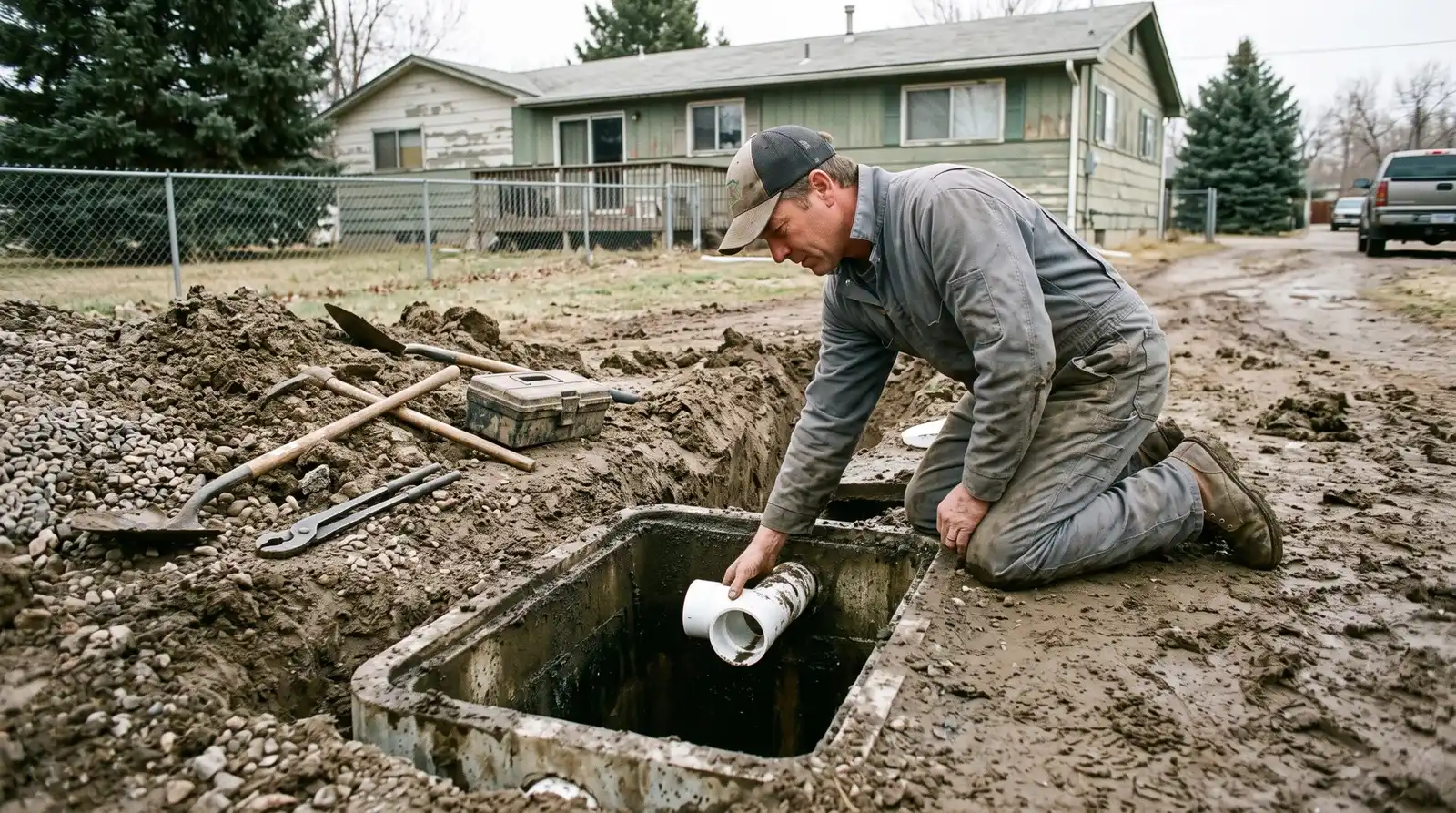
Septic repair means finding the specific component that failed, replacing or rebuilding it, and confirming the system runs correctly afterward. Most of what gets called a failed septic system is a broken baffle, a clogged effluent filter, a crushed line, a bad pump, or a saturated field, and those are four different jobs with four different price tags. Affordable Septic Pumping diagnoses before it quotes, across Denver and the Colorado Front Range. Call 720-427-7557.
Get Your Free Quote!
Licensing, experience, and credentials
The situation
Homeowners tend to describe the symptom rather than the failure, which is correct because the symptom is all you can see. The job is translating it. Slow drains through the whole house, a gurgling toilet, sewage odor in the yard, a wet spot over the field, an alarm going off, or waste backing up into a floor drain all have more than one possible cause.
The common component failures are these. The outlet baffle or tee deteriorates and stops holding the scum layer back, so grease and solids leave for the field. The effluent filter clogs and the tank backs up toward the house. A riser or lid cracks and lets surface water in. A line between the house and the tank crushes, settles, or fills with roots. In a pumped system the pump, float, or alarm fails. And in the worst case, the drain field soil clogs and stops accepting effluent.
Match your symptom to the likely cause before you call and the conversation gets faster. Start with a gurgling toilet, slow drains through the whole house, sewage smell in the yard, a wet spot over the leach field, a septic alarm going off, roots in the septic line, or standing water near the septic tank.
If waste is already inside the building, that is not a scheduled repair. Go to emergency septic service and call 720-427-7557.

How the job runs

When it started, what changed, when the tank was last pumped, whether the house had a plumbing issue, and whether the ground has been wet. Half of a diagnosis is the timeline.
The liquid level relative to the outlet invert is the single most informative thing on the property. High means effluent is not leaving. Low means it is leaving somewhere it should not.
Nothing inside the tank can be evaluated through liquid. Pumping is normally the first physical step of a repair, not an upsell.
Inlet baffle, outlet baffle or tee, effluent filter, tank walls and joints, lids, risers, and any [distribution box](/distribution-box), [pump chamber or lift station](/pump-chamber-and-lift-station), float, or alarm the system carries.
Water is run from the house to confirm the inlet line flows freely, and the refill behavior on the outlet side shows whether the field is accepting effluent or pushing back.
You get told what failed, what it takes to fix it, and what it costs. If more than one component is at end of life, you get the list sorted by what has to happen now versus what can wait.
The repair gets made, the system gets run again, and we confirm the symptom is gone before we close up and backfill.
These are the jobs we do most often, roughly in order of how frequently they come up.
Repair is right when the failure is a discrete component and the drain field is still accepting effluent. Replacement enters the conversation when the field itself has failed, when the tank structure is compromised, when the system is undersized for how the property is actually used, or when the design is obsolete enough that a repair will not be permitted.
The field is the deciding factor. Soil that has clogged with solids does not recover, and no additive, pumping schedule, or component swap changes that. Septic repair versus replacement in Colorado walks through the decision, septic system lifespan in Colorado covers what to expect by age, and septic repair cost in Colorado and drain field replacement cost in Colorado cover both sides of the money question.
We will tell you when a repair is a stopgap. Spending real money on a component in a system that is going to be replaced within a year is not a favor to anybody, and we would rather lose that job than sell it.
A failed outlet baffle is the clearest example. Nothing appears to be wrong from inside the house, so it is easy to defer. Meanwhile grease and solids that the baffle used to hold back leave the tank on every flush and settle into the soil pores of the drain field. That is the mechanism that turns a bounded repair into a system replacement.
A clogged effluent filter goes the other direction. Effluent stops leaving, the tank level climbs, and eventually waste comes back toward the house through the lowest fixture. That is a same day problem and it is often a same visit fix.
Standing sewage on the surface is also a health and liability issue on top of a plumbing one, especially where children, pets, or livestock use the yard. Effluent surfacing over the field explains what you are looking at.
Excavation scale work is a different lane. When the problem is out at the main sewer or water line rather than in the onsite system, our sister company Denver Sewer and Water handles that scope.
Interior house plumbing sits outside our scope. Fixtures, interior drain lines, and clogs inside the building go to our sister company Afford-A-Rooter Plumbing. Landscaping restoration beyond backfilling and grading the work area is not included, and neither is any permit fee charged directly by the county. We also do not sell additive products, because there is no additive that restores clogged drain field soil and we are not going to imply otherwise.
Why us
What it costs
The component that failed, how deep it sits, whether the tank has risers or has to be dug to, whether excavation equipment is needed, whether a permit applies, and the drive to your property. Replacing an effluent filter and replacing a drain field are separated by orders of magnitude, which is exactly why we diagnose before we quote instead of publishing a rate card that would be wrong in both directions. Call 720-427-7557, describe what you are seeing, and we will tell you what the likely causes are and what the visit costs. Septic repair cost in Colorado covers the ranges of work involved, and does homeowners insurance cover septic repair is worth reading before you assume it does not.
Questions
Keep going
Full system inspection for buyers, sellers, agents, and lenders.
Learn more about Septic Tank InspectionNew systems and full replacements, permit to final inspection.
Learn more about Septic System InstallationBackups, overflows, and failures that cannot wait for an opening.
Learn more about Emergency Septic ServiceGuides on what fails, what it costs, and how to decide between fixing and replacing.
Family Owned & Operated. Call 720-427-7557 or send the form and we will get back to you with a straight answer.