
This guide is part of Septic Service Cost. For the service itself, see our full septic service cost guide.
Drain field replacement in Colorado is usually one of the more expensive septic projects because it involves more than swapping out a single part. The final cost depends on the size and condition of the field, soil and site conditions, access for excavation, permit requirements, and whether the job truly stays in the drain-field lane or expands into full system replacement.
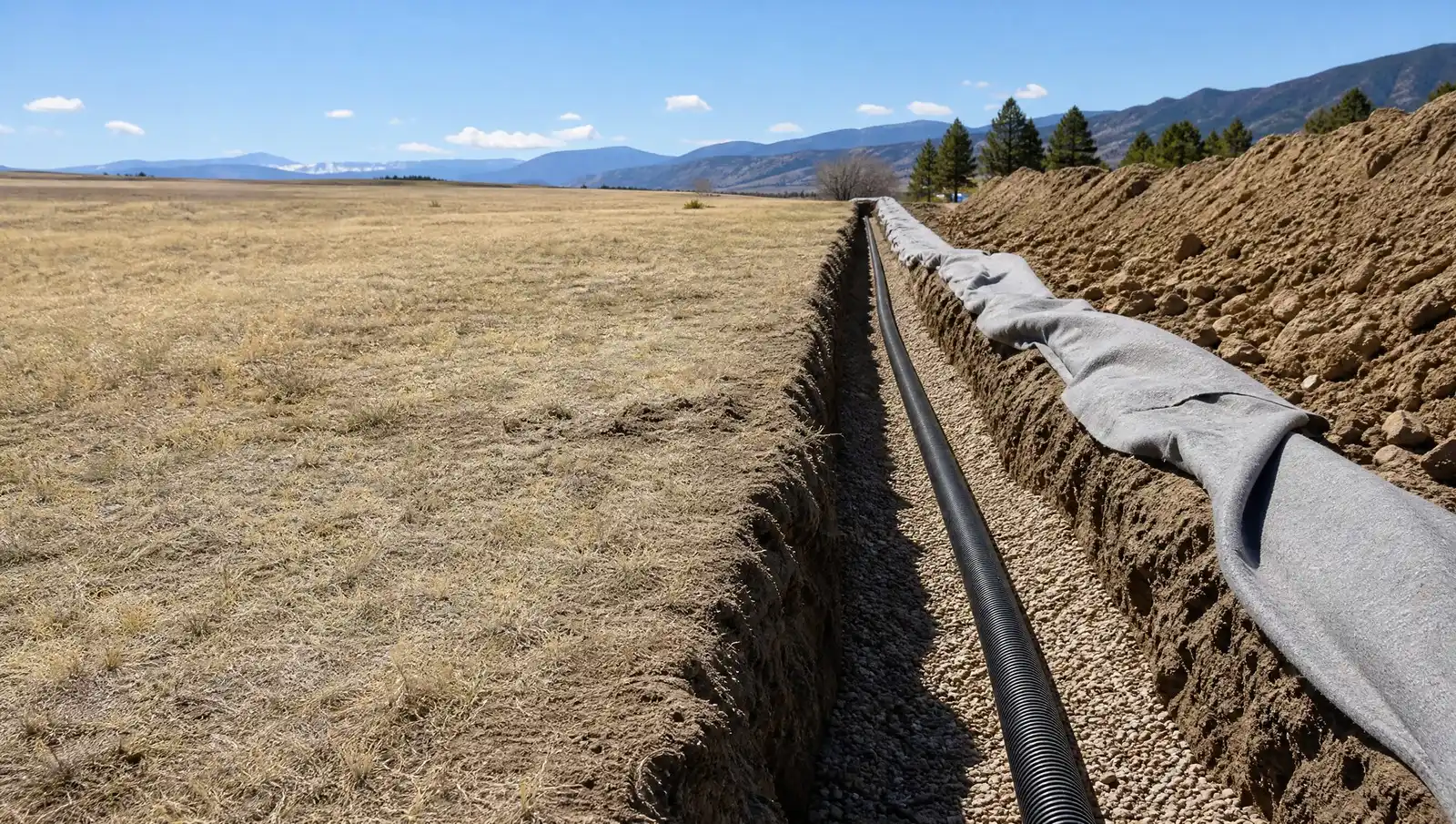
Drain field replacement Drain field replacement is the construction of a new soil treatment and dispersal area for a septic system, including excavation, materials, layout decisions, and county permitting rather than a simple component swap.
Because the field is a large, site-dependent part of the system, replacement behaves like a construction project and prices far above a normal septic repair.
If you are dealing with a confirmed septic problem, you can review our drain field replacement page here.
What is a realistic drain field replacement cost range in Colorado?
A realistic starting range for drain field replacement is usually in the low thousands and can move well into five figures when the site is difficult or the replacement requires a more complex design. Current national pricing sources commonly place drain or leach field replacement around $3,000 to $15,000, while broader field-failure ranges can stretch higher when the work is extensive.
That range is useful for planning, but it is not a real quote. A field replacement on an accessible lot with favorable soil is a very different job from one that requires major excavation, engineering, or an alternative system layout.
| Project type | Typical cost direction | What it usually includes | Why the price changes |
|---|---|---|---|
| Limited field repair or rejuvenation | Lower end | Targeted work short of full replacement | Scope stays smaller and excavation is more limited |
| Standard drain field replacement | Mid range | New field area, excavation, materials, reconnection | Size, soil, and access drive most of the variation |
| Replacement on a difficult site | Higher | More excavation, grading, or layout adjustment | Slope, rocky soils, tight access, or drainage challenges |
| Engineered or alternative field solution | Higher to upper end | More complex design and installation approach | Site limitations can require added materials and design work |
| Field replacement plus broader system work | Highest | Drain field work plus other major septic components | The project may no longer be field-only |
The most important takeaway is that drain field replacement cost changes fast once the job requires engineering, extensive earthwork, or more than one major system element.
Why is drain field replacement usually more expensive than a normal septic repair?
Drain field replacement usually costs more because the field is part of the system’s treatment and dispersal area, not just a single serviceable part. Replacing it typically means excavation, site work, material installation, layout decisions, and county permitting rather than a simple component swap.
That is why homeowners should think of field replacement as a construction project, not just a repair visit. Our leach field page covers how the dispersal area actually works.
What factors usually raise or lower the price?
The biggest cost drivers are field size, soil conditions, slope, access, design type, and permit requirements. Those variables matter more than any average number you see online.
Does soil and site condition matter that much?
Yes. Soil and site conditions are some of the biggest reasons one field replacement costs much more than another. If the lot has difficult drainage, poor perc performance, steep slope, shallow limiting layers, or restricted usable area, the replacement may require more excavation or a different treatment approach.
This is one reason Colorado projects can vary so much. Site conditions are not just a technical issue. They are a direct cost driver.
Does field size affect the cost?
Yes. Larger homes or systems that need a larger soil treatment area generally cost more because they require more excavation, more materials, and more installation labor. The size of the required field is part of why small and large properties can land in very different budget ranges.
A replacement also may not go back into exactly the same footprint if the original area is no longer suitable.
Can access and excavation make the project much more expensive?
Absolutely. A flat, open yard is easier to work in than a sloped, rocky, landscaped, or tight-access site. Equipment access, spoil handling, grading, and restoration can all add meaningful cost before the new field is even in place.
This is where homeowners often underestimate the project. The cost is not just the field materials. It is everything required to build the replacement correctly.
Do permits and county rules affect drain field replacement cost in Colorado?
Yes. Colorado counties regulate onsite wastewater systems locally, and field replacement is often treated as a significant permit category rather than a small repair. Boulder County’s fee schedule lists major repair permits for soil treatment area repair or replacement for aging or failing systems. Larimer County says a major repair permit is needed when repairs involve replacing, expanding, or changing the soil treatment area.
That means the project budget may include permit fees, plan review, inspections, and county-specific requirements in addition to construction cost.
When does a drain field project stop being “field only”?
A drain field project stops being field-only when the work also involves the tank, major conveyance components, or a broader redesign of how the whole system works. At that point, the homeowner is no longer just replacing the field. The project may be moving into full system replacement or an engineered-system decision.
That boundary matters because a field-only cost article should not be treated like a full septic replacement quote.
Use this checklist before comparing drain field replacement estimates:
- Ask whether the quote is for field replacement only or for broader system work too.
- Confirm whether engineering or redesign is included.
- Ask whether county permit fees and inspections are included.
- Ask what site conditions could change the price after excavation begins.
- Confirm whether grading, restoration, or landscaping repair is included.
- Ask whether the existing tank and conveyance components are expected to remain in service.
If you need a broader starting point on septic service paths, you can review our septic services overview here.
Can a failing drain field be repaired instead of replaced?
Sometimes limited field issues can be addressed without full replacement, but a truly failing or clogged field often pushes the project toward replacement. HomeGuide’s current pricing notes field repair or rejuvenation at roughly $1,000 to $5,000, while full replacement commonly runs $3,000 to $15,000.
That is why diagnosis matters so much. A homeowner may search for “repair,” but the actual condition of the field may already put the project in replacement territory. Our guide to drain field failure signs covers what that condition usually looks like.
What does this look like in real life?
A realistic example is a homeowner in a relatively open Front Range lot where the drain field has clearly failed, but the tank remains serviceable and the replacement can stay in a standard field footprint. That kind of project may stay closer to the middle of the common replacement range.
Another common example is a mountain-adjacent property with slope, limited usable area, and difficult soil conditions. In that case, the drain field replacement may require a more engineered approach, more earthwork, and a much higher budget than a simple “average cost” article suggests.
What mistakes do homeowners make when budgeting for drain field replacement?
The most common mistake is assuming drain field replacement should cost about the same as a normal septic repair. It usually does not. The field is a large, site-dependent part of the system, and replacing it often means significant excavation and permitting.
Another mistake is comparing a field-only quote to a quote that includes redesign, engineering, grading, or work on other septic components. Those are not the same project, even if both are loosely called “replacement.”
Red flags to watch for
Be cautious if a quote does not explain whether the field has actually failed, whether the tank is still usable, or whether engineering and permit costs are included. It is also worth slowing down if the site has slope, poor access, or known soil limitations and the estimate still assumes a very simple install.
A good estimate should define the project boundary clearly.
Not sure where your drain field stands or what replacement would run on your lot?
The best next step is to confirm whether the field is the only major system element that needs replacement and then compare estimates built on the same scope. That usually gives a more useful budget picture than relying on one internet number.
Our septic services page is the place to start if you want to see how drain field work fits alongside pumping, inspection, and repair.
Final takeaway
In Colorado, drain field replacement cost is mainly shaped by site conditions, field size, excavation difficulty, county permit requirements, and whether the job truly stays in the drain-field lane. A standard field replacement may stay in the common replacement range, but complex sites and engineered solutions can push the project much higher.
If you are dealing with a confirmed field-related issue, start with our drain field replacement page here.