This guide is part of Septic Service Cost. For the service itself, see our full septic service cost guide.
Installing or fully replacing a septic system in Colorado is usually a major construction project, not a simple repair. The final cost depends on the type of system the property needs, the soil and site conditions, county permit requirements, design and engineering work, excavation difficulty, and whether the project is a basic gravity system or a more advanced treatment setup.
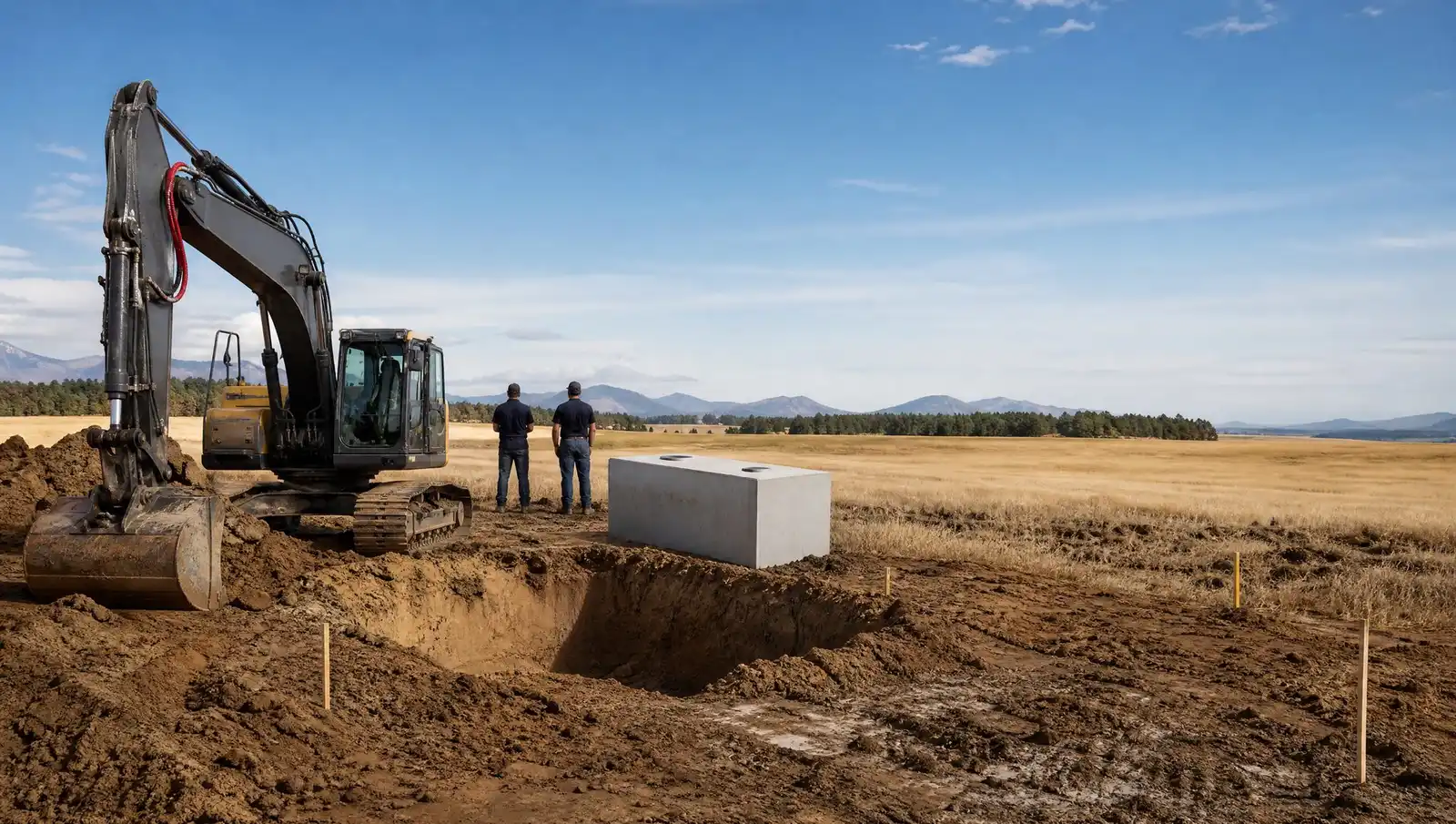
Full septic system installation A full septic installation or replacement is the design, permitting, and construction of a complete onsite wastewater system, including site evaluation, tank and treatment components, soil treatment area, excavation, and final county approval.
Because the site and the required system type decide the design, whole-system pricing swings far more than any single statewide average suggests.
If you are already planning a new system or full replacement, you can review the Affordable Septic Pumping septic system installation services page, which outlines how new systems are designed, permitted, and installed.
What is a realistic septic installation or full replacement cost range in Colorado?
A realistic starting range for septic system installation or full replacement in Colorado often begins in the low five figures for more straightforward projects and climbs much higher when the lot requires engineering, advanced treatment, or difficult site work. Published national and Colorado-oriented pricing commonly places standard septic installation in a broad range from about $7,000 to $25,000, with more complex systems rising above that.
That range is useful for planning, but it is not a true quote. A basic gravity-fed system on a buildable lot is very different from a higher-level treatment system on a constrained site.
| Project type | Typical cost direction | What it usually includes | Why the price changes |
|---|---|---|---|
| Basic conventional system | Lower end of the replacement/install range | Tank, standard soil treatment area, normal excavation | Simpler design and fewer added components |
| Pressure-dosed or engineered system | Mid to higher | Added design work, pumps, controls, more complex layout | Site limitations often require more equipment and planning |
| Higher-level treatment system | Higher | Advanced treatment equipment plus ongoing operation requirements | More components, more oversight, and more complexity |
| Mountain, rocky, or difficult-access site | Higher | More excavation, grading, haul-off, or access work | Site conditions raise labor and equipment cost |
| Full replacement with broad redesign | Highest | New system design, permit path, construction, and possibly operating-permit obligations | The project is rebuilding how wastewater is treated onsite |
The most important takeaway is that whole-system cost depends on the required system type and the property itself, not just on one statewide average.
Why do full-system septic costs vary so much?
Full-system costs vary because a septic system has to match the site, the soil, the home size, and the local regulatory requirements. The same number of bedrooms can still produce very different installation costs if one lot supports a standard gravity layout and another requires engineering or higher-level treatment.
That is why broad internet averages should be treated as orientation, not as budget certainty. Our walkthrough of the new construction septic installation process shows where those decisions get made.
What are the biggest cost drivers for installation or full replacement?
The biggest cost drivers are the required system type, soil and site conditions, design work, permit fees, excavation difficulty, and whether the county requires ongoing operating-permit or maintenance obligations after installation.
Does soil and site testing affect the cost?
Yes. Soil and site evaluation are foundational cost drivers because they determine what kind of system the property can support. If the site has poor soil conditions, shallow limiting layers, slope, restricted usable area, or drainage constraints, the system may need to be engineered differently and that usually raises cost.
This is one reason septic pricing in Colorado is highly site-specific. The lot itself helps determine the system design.
Do county permits and design requirements matter that much?
Yes. Colorado handles OWTS permitting locally for systems up to 2,000 gallons per day, so counties can shape both the process and the cost. Permit fees, design review, inspections, and required revisions can all add to the total budget, especially on replacement projects or lots needing more specialized treatment.
That means a full-system cost estimate should never ignore the county side of the project.
Does advanced treatment raise the price a lot?
Usually, yes. If the site cannot support a standard system, the property may need a pressure-dosed, engineered, or higher-level treatment design. Those systems often involve more equipment, more installation complexity, and in some counties an operating permit that continues after construction. Our aerobic treatment unit page explains how that equipment works.
This is one of the biggest reasons some septic projects stay near the lower end of the range while others rise sharply.
What is usually included in a full septic installation or replacement budget?
A full-system budget often includes site evaluation, design or engineering, permit fees, tank and treatment components, excavation, system installation, inspections, and final approval. Depending on the site, it may also include grading, haul-off, restoration, electrical work for pumps or alarms, and added documentation.
The scope is one of the biggest reasons homeowners get confusing quotes. Some estimates include design and permit work, while others only cover construction.
Use this checklist before comparing full-system estimates:
- Ask whether the quote includes design and engineering.
- Confirm whether county permit fees and inspections are included.
- Ask what system type the estimate assumes.
- Ask whether electrical work, pumps, or controls are included.
- Confirm whether grading, restoration, or haul-off is included.
- Ask what site conditions could change the price after excavation begins.
If you are still sorting out the right service path, you can review our septic services overview.
When is a project truly a full replacement rather than a repair?
A project is truly a full replacement when the tank, soil treatment area, or multiple major components have reached the point where rebuilding the system is more realistic than fixing isolated parts. Once the system needs a new design, new construction, or a new treatment approach, the project is no longer a normal repair.
That boundary matters because installation and replacement costs should not be compared directly to small repair estimates.
Do Colorado counties add ongoing requirements for some systems?
Yes. Some higher-level treatment systems come with operating-permit obligations or ongoing service expectations after installation. Jefferson County says all higher-level treatment systems receive an operating permit upon completion and require an O&M contract during the application process. Clear Creek County likewise notes that higher-level treatment systems require an operating permit.
That means some septic systems carry not only higher upfront costs but also a more involved post-installation responsibility.
| Cost driver | Why it matters | Lower-cost version | Higher-cost version |
|---|---|---|---|
| System type | Basic systems cost less than advanced treatment systems | Conventional gravity layout | Engineered, pressure-dosed, or higher-level treatment system |
| Site conditions | Soil, slope, and access change the construction method | Open lot with suitable soils | Rocky, sloped, constrained, or difficult site |
| Design and permitting | More review means more time and cost before construction | Standard local approval path | Added design revisions, special review, operating permit obligations |
| Project scope | Whole-system work costs more than limited component correction | Partial repair | Full replacement with redesign |
What does this look like in real life?
A realistic example is a homeowner on a buildable Front Range lot with soils and layout that allow a conventional system. That kind of project may stay closer to the common lower end of the install range because the design and construction path are more straightforward.
Another common example is a property with restricted usable area, rocky ground, and a need for higher-level treatment or pressure distribution. In that case, the project can move well above the standard range because the cost is driven by design complexity, equipment, permitting, and construction difficulty.
What mistakes do homeowners make when budgeting for full installation or replacement?
The most common mistake is comparing a basic conventional-system estimate to an engineered or higher-level-treatment estimate as if they describe the same kind of project. They do not.
Another mistake is focusing only on tank price and ignoring soil testing, design, permits, excavation, electrical work, and final approval. Those items are often a meaningful part of the real project budget.
Red flags to watch for
Be cautious if an estimate does not identify the assumed system type, excludes permit or design costs without saying so, or treats a difficult site like a basic installation. It is also worth slowing down if the property may require advanced treatment but the estimate still reads like a simple gravity-system job.
A useful estimate should define the system and the site assumptions clearly.
Still weighing what a new system would cost on your property?
The best next step is to confirm what system type the site can support and then compare estimates based on the same design assumptions. That usually gives a much more realistic budget picture than relying on one statewide or national average.
Installation is the start of a long relationship with a system, and our septic services page covers what comes after.
Final takeaway
In Colorado, septic installation and full replacement cost are driven by system type, soil and site conditions, county permit requirements, engineering, and construction difficulty. A straightforward conventional system may stay near the lower end of the broad install range, while engineered and higher-level treatment systems can rise much higher.
If you are planning a new system or full replacement, start with our septic system installation page.