This guide is part of Commercial and Grease Trap. For the service itself, see our commercial grease trap services.
Grease traps do not announce themselves when they need service. They back up, they smell, and in a restaurant setting they can create the kind of disruption no kitchen manager wants. The question most Denver-area restaurant owners ask is not whether to clean a grease trap, it is how often, and what happens if they let it go too long.
The 25% rule The most widely used industry standard for grease trap pumping. A trap should be pumped when the combined depth of floating grease and settled solids reaches 25% of the trap's total liquid depth.
At that point the trap is no longer effectively intercepting grease before it enters the sewer line, so grease passes through and begins accumulating in the downstream pipes.
The answer depends on the type of trap, how much the kitchen produces, what goes into the drain, and what the local authority requires. This guide covers the practical framework for grease trap cleaning frequency for restaurants and food service operations in the Denver metro area. If you already know you are overdue, our grease trap cleaning service in Denver covers what a service call involves.
The 25% Rule and Why It Matters
The most widely used industry standard for grease trap pumping is the 25% rule: a trap should be pumped when the combined depth of floating grease and settled solids reaches 25% of the trap's total liquid depth. At that point, the trap is no longer effectively intercepting grease before it enters the sewer line. Allowing it to exceed that threshold means grease passes through and begins accumulating in the downstream pipes, which is both a code violation and a drain problem that gets progressively more expensive to address.
Most health departments and wastewater authorities in the Denver metro area, including Denver Water and the various county environmental health offices, follow or reference this standard. Some have stricter thresholds. The practical consequence is that the 25% mark is not a recommendation, it is effectively a compliance line. Exceeding it during an inspection can result in a notice of violation, a requirement to pump immediately, and in some cases a reinspection fee.
The reason the rule is set at 25% rather than 50% or full is that trap efficiency drops well before it looks full. A trap that is 25% loaded with grease cap and solids is already allowing some grease to pass into the system. By the time it looks full, it has been actively contributing to sewer line buildup for some time.
Typical Cleaning Frequencies by Operation Type
There is no single interval that fits every restaurant. Frequency depends on trap size, kitchen volume, menu type, and how much of the cooking involves high-fat items. As a practical guide, here is how cleaning intervals typically break down for common food service types in the Denver area:
| Operation type | Typical interval | What puts an operation here |
|---|---|---|
| High-volume kitchens | Weekly to every two weeks | Significant fry production, large catering operations, or high daily covers (300+). Fast casual chains with heavy fryer use, chicken and burger concepts, and commercial food prep facilities commonly fall into this category. |
| Mid-volume full-service restaurants | Monthly to every six weeks | A varied menu, moderate fryer use, and average daily covers in the 100 to 250 range. This is the most common interval for independently owned restaurants in Denver's neighborhoods. |
| Lower-volume or limited-menu operations | Every two to three months | Coffee shops, sandwich concepts, light breakfast spots, and other operations with minimal frying and lower grease-producing output can often extend intervals to every eight to twelve weeks. |
| Commercial kitchens in schools, hospitals, and institutions | Quarterly with monitoring | Larger traps and more predictable menus. Most have maintenance contracts with defined intervals and documentation requirements that coordinate with facility management. |
High-volume kitchens, weekly to every two weeks. Restaurants with significant fry production, large catering operations, or high daily covers (300+) often need service every one to two weeks. Fast casual chains with heavy fryer use, chicken and burger concepts, and commercial food prep facilities commonly fall into this category. A trap that is undersized for a kitchen's actual volume will need even more frequent attention.
Mid-volume full-service restaurants, monthly to every six weeks. A typical full-service restaurant with a varied menu, moderate fryer use, and average daily covers in the 100 to 250 range often lands in the monthly to every-six-week range. This is the most common interval for independently owned restaurants in Denver's neighborhoods.
Lower-volume or limited-menu operations, every two to three months. Coffee shops, sandwich concepts, light breakfast spots, and other operations with minimal frying and lower grease-producing output can often extend intervals to every eight to twelve weeks. However, this assumes the trap was sized correctly for the kitchen's actual use, an undersized trap needs service more frequently regardless of volume.
Commercial kitchens in schools, hospitals, and institutions, quarterly with monitoring. Institutional kitchens often have larger traps and more predictable menus, which can support quarterly service intervals. Most have maintenance contracts with defined intervals and documentation requirements that coordinate with facility management. Larger sites often pair that schedule with commercial and restaurant septic service when the property is not on a public sewer.
Grease Interceptors vs. Hydromechanical Grease Traps
The term "grease trap" is used loosely to describe two distinct types of equipment. Understanding which type your facility has affects how you schedule and budget for service.
A hydromechanical grease trap (also called an in-line grease trap) is a smaller unit typically installed under the sink or in the floor near the kitchen drain. These are common in smaller restaurants and older buildings. They are less expensive to install but hold significantly less volume, which means they fill faster and need more frequent pumping, sometimes weekly for a busy kitchen. They are also more prone to odor issues when neglected, since the retained grease is close to the kitchen.
A grease interceptor (sometimes called an exterior grease trap) is a larger buried tank, typically installed outside the building or in a utility area. These hold much more volume, are more effective at intercepting grease from the full kitchen load, and generally need less frequent service than hydromechanical traps. Most new commercial construction in the Denver area requires a properly sized interceptor rather than an in-line trap. If your facility uses a large exterior interceptor, it may qualify for quarterly or even biannual service intervals depending on volume, though the 25% rule still applies and monitoring is the only reliable way to know where you stand.
Our grease trap services page covers both types, and our grease trap installation page has information for facilities evaluating an upgrade from an in-line trap to a properly sized interceptor.
What Happens During a Grease Trap Cleaning
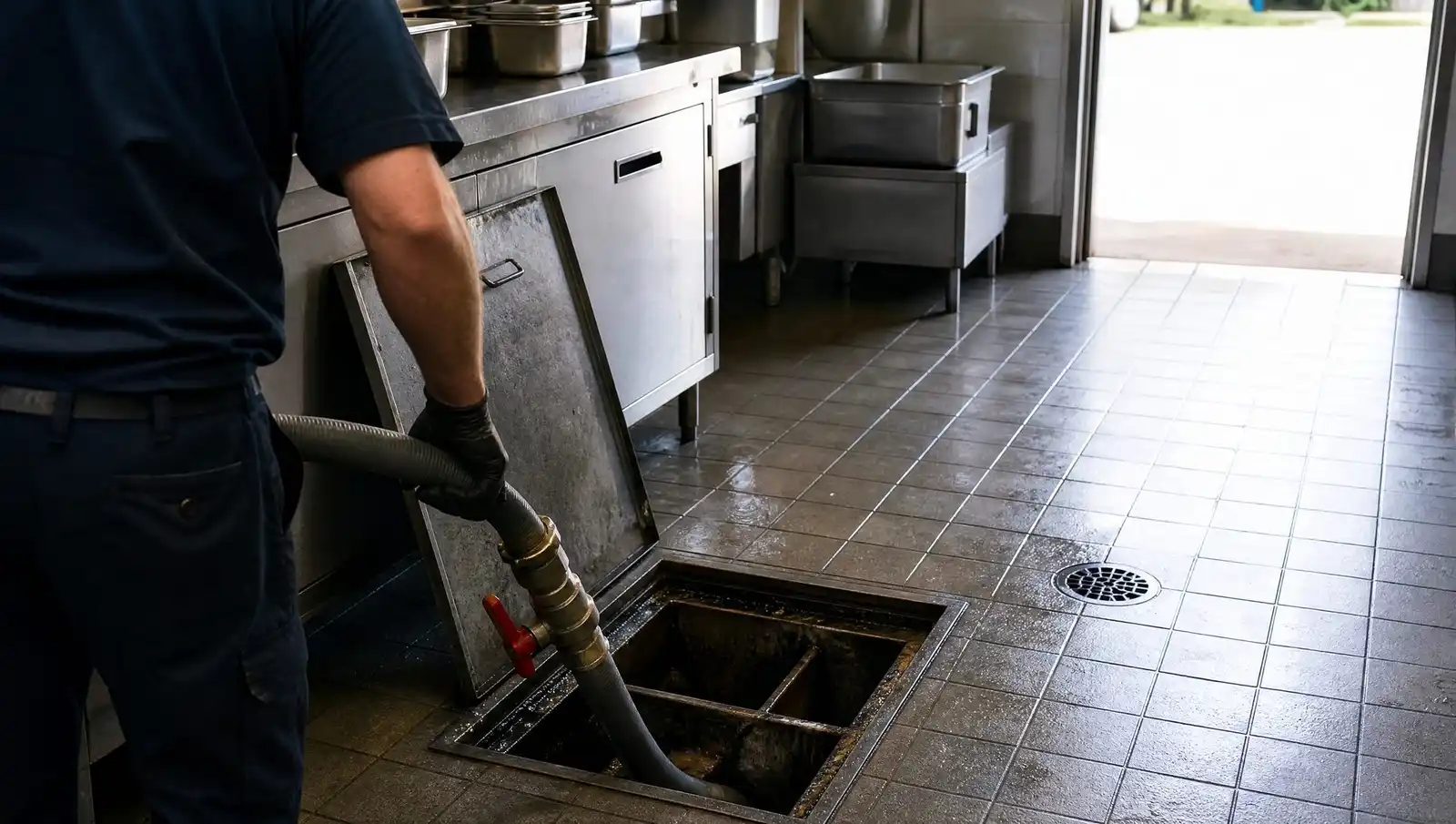
A professional grease trap cleaning involves vacuum pumping the contents of the trap, the floating grease cap, the wastewater layer, and the settled solids at the bottom. Unlike a quick pump that removes only the liquid layer, a thorough cleaning removes all three layers and ensures the trap is functioning at full capacity after the visit.
After pumping, the technician typically inspects the trap's baffles and interior surfaces, checks the inlet and outlet conditions, and notes any damage, buildup, or operational concerns. Grease traps with damaged baffles are less effective even when recently pumped, since the baffle is what separates the grease cap from the outlet flow. A trap that has not been fully cleaned, where grease adhering to the walls and baffles is left behind, returns to reduced capacity faster than one that was thoroughly serviced.
Documentation matters in a commercial setting. Wastewater authorities and health departments may request cleaning records during inspections. Keeping a log of service dates, the service provider, and the waste manifest (showing proper disposal of the pumped material) is the standard in most jurisdictions. Grease trap waste must be disposed of at an approved facility, it cannot be dumped on-site or in the sanitary sewer.
The Cost of Waiting Too Long
Skipping scheduled grease trap service has a predictable set of consequences. The most immediate is backup. When grease passes the trap and accumulates in the building's drain lines, it solidifies and restricts flow. A blocked kitchen drain during service hours is an expensive disruption, and clearing a grease-blocked line requires more than a standard drain snaking. It typically involves hydrojetting to cut through the accumulation, which costs significantly more than routine trap cleaning.
Downstream, grease accumulation in the public sewer system can lead to fatbergs, large solidified masses of grease, wipes, and debris that block sewer mains. Denver Water and many municipal systems actively monitor for grease-contributing sources and can assess fines against facilities identified as contributors to sewer blockages. Those fines, combined with emergency service costs and the potential for a health department citation, add up to outcomes that are far more disruptive and expensive than keeping a grease trap on a reliable schedule.
If you are already dealing with a slow kitchen drain, a trap that smells even when recently pumped, or a drain backup, those are signs the system needs immediate attention rather than a wait-and-see approach. Our grease trap cleaning page covers what to expect from a service call and how to reach us for urgent needs, and our restaurant grease trap service in Denver is built around kitchens that cannot afford downtime.
Setting Up a Maintenance Schedule That Works
The most practical approach for most Denver-area restaurants is to establish a baseline service interval, monthly for most mid-volume operations, and then adjust based on actual trap condition at each visit. A technician who records the grease and solids depth at each cleaning gives you real data to optimize the schedule over time. If the trap is consistently at 15% when serviced monthly, you may be able to extend to every six weeks. If it is consistently at or above 25% within three weeks, the interval needs to tighten or the trap needs to be upsized.
A service contract or scheduled recurring appointment removes the scheduling burden and ensures compliance documentation stays current. For multi-location operators, coordinating service across locations with a single provider simplifies record-keeping and reduces the risk of a missed interval at a busy site.
Affordable Septic Pumping provides grease trap cleaning, pumping, and maintenance service for restaurants and commercial food service operations throughout the Denver metro area and Front Range. Call (720) 427-7557 or visit our grease trap services page to discuss a schedule that fits your operation.