
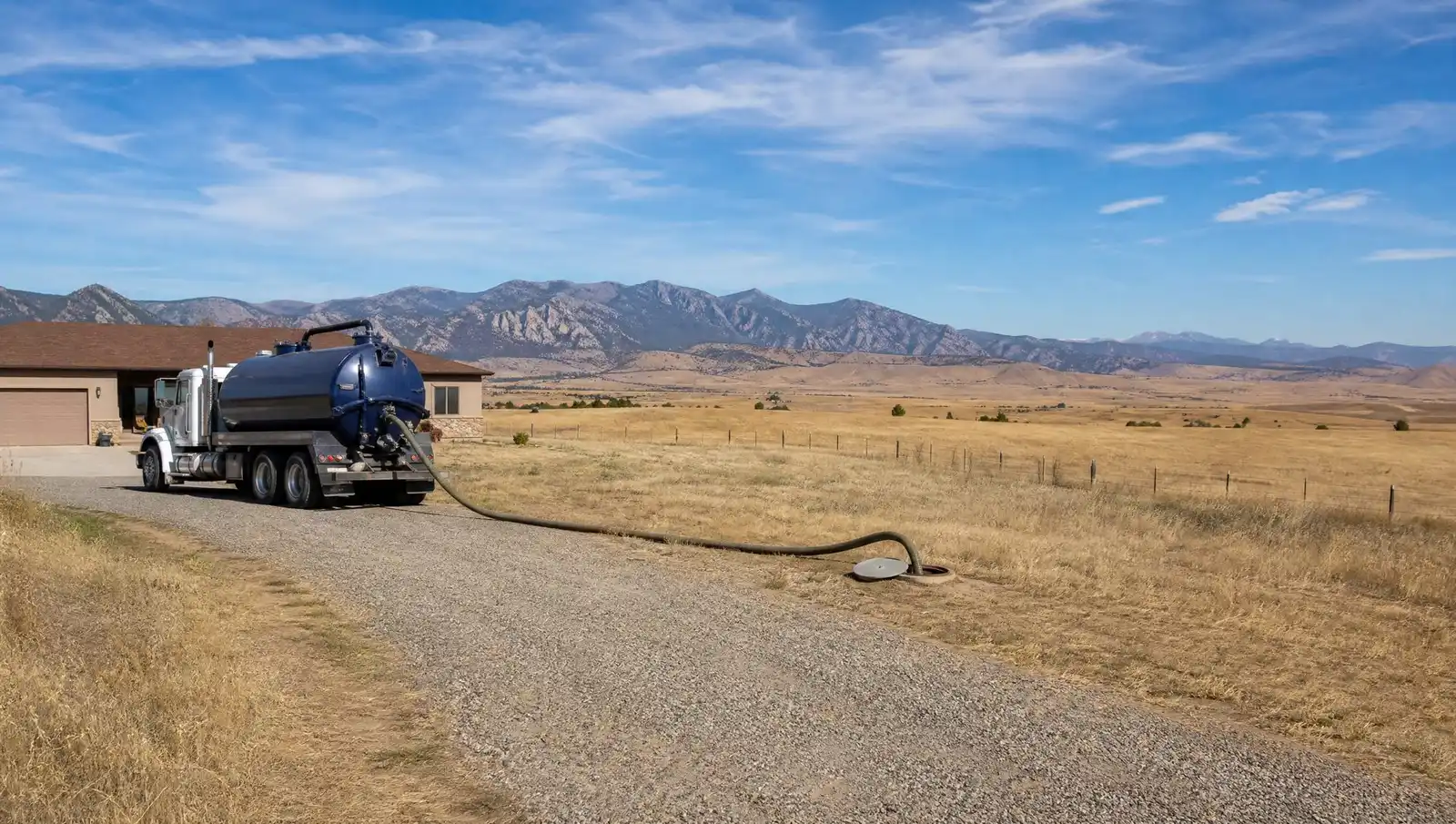
This guide is part of Septic Pumping and Maintenance. For the service itself, see our septic tank pumping service in Denver.
For many Colorado homes, septic tanks should be pumped about every three to five years, but that is only a starting point. The right schedule depends on tank size, how many people live in the home, how much water the household uses, and whether the system shows signs that solids are building up faster than expected.
Septic pumping frequency. Septic pumping frequency is how often the accumulated solids are removed from a septic tank. For many Colorado homes that is about every three to five years, adjusted for tank size, household size, and water use.
A schedule that matches the system lowers the chance that a routine maintenance need turns into a backup or repair problem.
If you already know your system is due, you can review our septic tank pumping page here.
Is every three to five years a good rule of thumb in Colorado?
Yes, for many conventional household systems, every three to five years is a reasonable starting guideline. That range lines up with EPA homeowner guidance and with common recommendations from Colorado local health programs.
The important part is that a rule of thumb is not the same thing as a guaranteed schedule. A smaller tank serving a larger household may need pumping sooner, while a larger tank serving fewer people may go longer between services.
| Household situation | Typical pumping direction | Why the schedule changes | What to watch for |
|---|---|---|---|
| Smaller household with moderate water use | Longer interval within the normal range | Fewer solids and less wastewater | Keep records so you do not lose track of timing |
| Average family on a conventional system | Mid-range interval | Normal solids buildup over time | Stay ahead of symptoms instead of waiting for slow drains |
| Larger household or high water use | Shorter interval | More wastewater and faster solids accumulation | Watch for backups, odors, or recurring sluggish fixtures |
| Home with a garbage disposal or heavy food waste | Shorter interval | More solids entering the tank | Expect the tank to fill faster than average |
| Alternative or mechanical system | More frequent inspection, pumping as needed | Added components need closer monitoring | Follow the system-specific maintenance plan |
The takeaway is simple: use the three-to-five-year range as a starting point, then adjust based on how your household actually uses the system. Our overview of how often to pump a septic tank walks through the same decision from the service side.
What factors change how often a septic tank should be pumped?
Four factors usually matter most: tank size, household size, water use, and how much solid waste enters the system. Those variables matter more than a one-size-fits-all calendar.
Does tank size change the schedule?
Yes. Smaller tanks fill with solids faster and usually need pumping sooner than larger tanks. If two homes have the same number of occupants but one has a smaller tank, the smaller tank will usually need service first.
This is one reason property records and past service notes are useful. If you do not know your tank size, the safest approach is to avoid guessing and ask a professional to help verify it.
Does household size matter more than people think?
Yes. More people usually means more wastewater, more solids, and more frequent pumping. Even a well-sized tank can fill faster when a home has grown from two occupants to five or more.
This is especially important in homes with long-term guests, multigenerational living arrangements, or rental turnover that changes the real usage pattern.
Can water use habits shorten the interval?
Absolutely. Heavy laundry days, long showers, leaking fixtures, and frequent dishwasher use all increase the amount of water entering the system. That does not always mean the tank fills with solids faster, but it can put more stress on the overall system.
A septic system usually performs best when water use is spread out instead of concentrated into short periods.
Does a garbage disposal make pumping more frequent?
In many homes, yes. Food waste adds solids to the tank, which can shorten the time between pump-outs.
That does not mean every home with a garbage disposal has a septic problem. It does mean the pumping schedule often needs to be more conservative.
Are Colorado-specific rules different from the general guideline?
Sometimes. State and local agencies generally support regular inspection and pumping as needed, but local programs may add their own expectations. For example, Arapahoe County says septic tanks must be inspected every four years and pumped when scum and sludge exceed the county's threshold.
That means homeowners should pay attention to both general maintenance guidance and any local program requirements that apply where the property is located.
What signs mean you should pump sooner instead of waiting?
You should move sooner if the system is showing warning signs rather than waiting for a calendar date to arrive. Slow drains, odors, backups, wet areas near the septic system, or gurgling plumbing can all mean the tank is overdue or that the system needs more than routine maintenance.
A timing guide is helpful, but the system's actual behavior matters more.
Use this checklist to decide whether your septic tank may be due now:
- You cannot remember the last pump-out date.
- It has been around three to five years since the last service.
- The household size has increased since the last pumping.
- The home uses a garbage disposal regularly.
- Drains are slower than usual or toilets gurgle.
- There are odors or wet spots near the yard or septic area.
If you are not sure where the tank is located or how to access it, we can help identify tank location and access points before the service visit.
Is pumping on a calendar enough, or should the system be inspected too?
A calendar helps, but inspection still matters. EPA guidance says the average household septic system should be inspected at least every three years, and alternative systems with pumps or mechanical parts generally need more frequent attention.
That matters because pumping is maintenance, while inspection helps catch problems early. A household that only thinks in terms of pumping dates can miss developing issues, which is why we also offer septic tank inspection in Denver as a separate service.
| Maintenance step | What it does | General timing guide | Why it matters |
|---|---|---|---|
| Pumping | Removes accumulated solids from the tank | Often every 3-5 years for many homes | Helps prevent solids from reaching the drain field |
| Inspection | Checks overall condition and function | At least every 3 years for many systems | Helps catch problems before they get expensive |
| Mechanical system review | Monitors pumps, alarms, and controls | Often yearly for alternative systems | Reduces risk of unnoticed component failure |
| Record review | Confirms past service and system details | Ongoing | Makes scheduling and troubleshooting easier |
What schedule is realistic for different kinds of households?
A realistic schedule depends on how the home is actually used, not just on what a generic chart says.
Example: A couple in a smaller Colorado home with a larger tank, moderate water use, and no garbage disposal may stay closer to the longer end of the normal pumping interval. Their best move is still to keep service records and avoid stretching beyond what the system history supports.
Example: A family of five in a Front Range home with a smaller tank, frequent laundry, and a garbage disposal may need a shorter pumping cycle to stay ahead of backups. Waiting for a problem would be a more expensive choice than routine maintenance.
What are common mistakes homeowners make with pumping frequency?
The most common mistake is treating septic pumping like a fixed number that never changes. Household size changes, usage habits change, and many owners lose track of the last service date after moving into the property.
Another mistake is waiting for obvious symptoms before acting. By the time sewage odors, yard wetness, or indoor backups appear, the system may already be under more stress than a simple routine visit would have prevented.
Red flags to watch for
Be cautious if your schedule is based only on guesswork, if nobody in the home knows the last pumping date, or if the household has changed significantly since the last service. It is also worth slowing down if repeated slow drains are being blamed on indoor plumbing without considering the septic system.
A good pumping schedule should be based on records and real usage, not hope.
What is the best next step if you are unsure about timing?
If you are unsure, the safest next step is to review the system history and schedule service or inspection based on the property's real conditions. That is usually better than waiting until the system starts forcing the decision.
Final takeaway
In Colorado, many septic tanks should be pumped every three to five years, but the best schedule depends on the tank, the household, and the way the property is used. The more accurately the schedule matches the system, the lower the chance that a routine maintenance need turns into a backup or repair problem.
If your system may be due, call Affordable Septic Pumping at 720-427-7557. We are a family business in Westminster serving the Denver metro and the Colorado Front Range.
Mountain homes may need to time that interval around snow and access, which our post on septic service in Evergreen, CO explains.