This guide is part of Septic Pumping and Maintenance. For the service itself, see our septic tank pumping service in Denver.
Septic tank pumping in rural Douglas County works best when it is planned around the property. Affordable Septic Pumping pumps tanks in Sedalia, Franktown, Larkspur, and the acreage between them, south of the Denver metro. The visit follows our septic tank pumping service in Denver, adjusted for long drives, rocky ground, and bigger loads.
| Area | Typical ground | What to plan for on pumping day |
|---|---|---|
| Sedalia bottom land | Deeper soil near Plum Creek | Level pull ins and short hose runs in most cases |
| Sedalia canyon parcels | Thin cover over rock toward Jarre Canyon | Road parking and a long hose pull |
| Franktown acreage | Gravelly and sandy, rock shelf in spots | Barns and shops that add flow to the tank |
| Larkspur slopes | Red sandstone and decomposed granite | Steep drives and engineered system parts |
Effective tank volume Effective tank volume is the liquid capacity of a septic tank that is actually available to settle and separate waste, which shrinks as scum and sludge build up.
Douglas County ties its pumping guidance to that volume. Once scum and sludge pass 25 percent of it, the tank is due.
How often should you pump a septic tank in Douglas County?
Douglas County recommends inspecting the septic tank every four years and pumping when scum and sludge exceed 25 percent of the tank's effective volume. For most households that lands at every three to five years. Affordable Septic Pumping measures the layers at each visit and sets your next date from those numbers.
A calendar rule is only a starting point. Household size, a garbage disposal, and guests all change the pace. Our guide to how often to pump a septic tank in Colorado explains how those factors stack up, our guide to how often to pump a cabin septic tank covers part time use, and the county asks that licensed systems cleaners handle evaluations and pump outs.
Why do rural Douglas County properties need more planning?
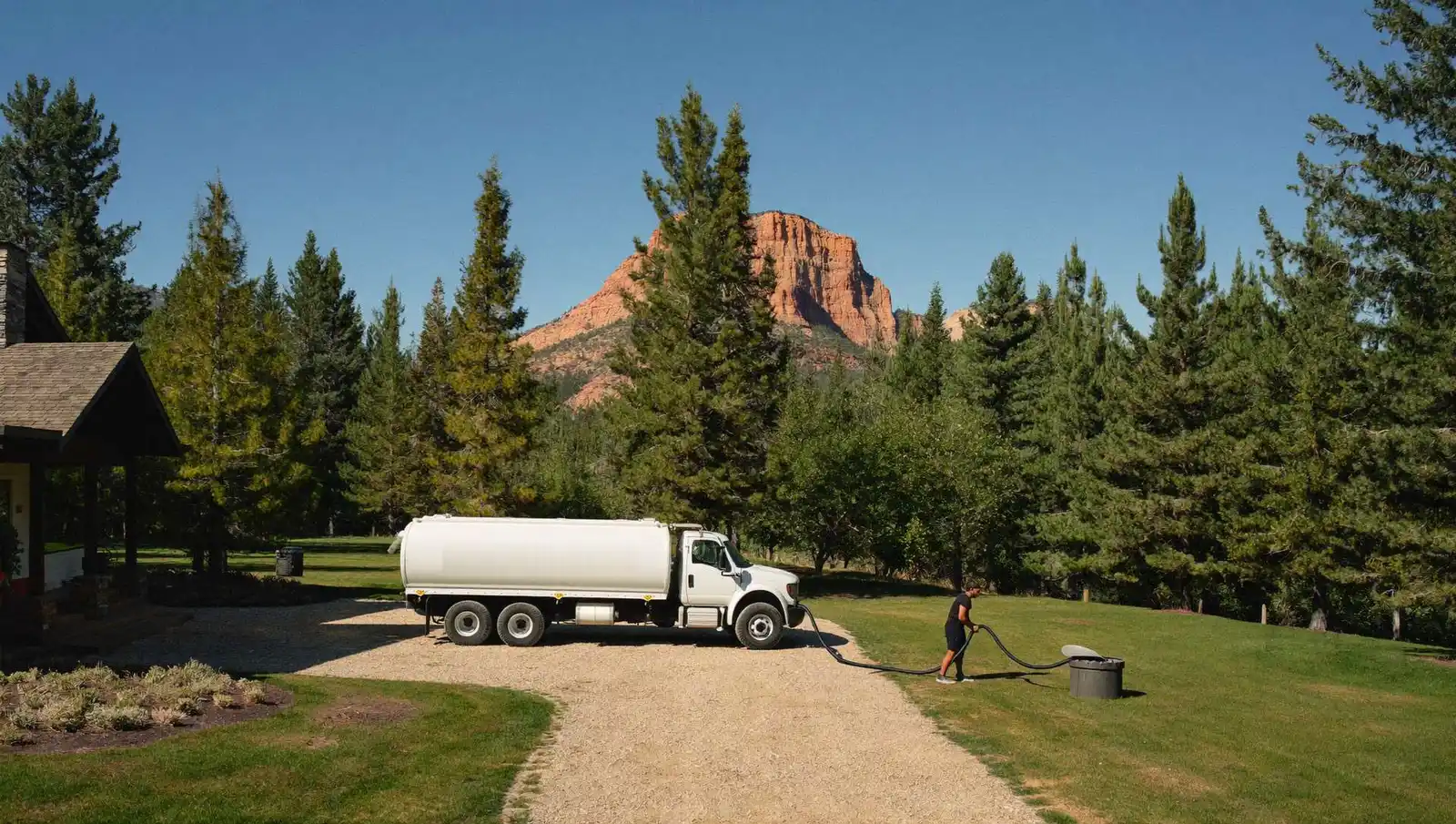
Rural Douglas County ground changes fast. A Sedalia address can be flat creek bottom or a canyon shelf. Franktown parcels shift from sandy soil to rock shelf across a fence line. Larkspur lots near Perry Park sit on red sandstone and decomposed granite. Each one changes where the truck parks and how far the crew pulls hose.
- Drive length and surface. A loaded vacuum truck needs firm ground to sit on and room to turn around.
- Lid location. Lids near the drive mean a short hose run. Lids across a pasture or up a slope take longer.
- System type. Engineered systems on thin soil carry pumps, floats, and alarms that get a look while the tank is open.
- Added load. Barns with sinks, heated shops with bathrooms, and second dwellings all feed the same tank.
Summer is a practical time to book on most of this ground. Dry drives and firm pasture hold a loaded truck better than soft ground does. If you are not sure where your lids are, our guide on how to find a septic tank lid walks through the checks to try before the visit.
Do barns and shops change how often Franktown acreage needs pumping?
Often, yes. Many Franktown and Douglas County acreage systems were sized for the original house. A barn sink, a shop bathroom, an arena washrack, or a second dwelling adds flow the tank was never designed to carry. The sign is a shorter gap between pump outs, and measured layers on two visits will show whether the change is real.
Our page on horse and ranch property septic covers that added load in more depth, and rural residential septic explains how acreage systems differ from a metro lot.
What does a Douglas County septic pumping visit include?
A Douglas County pumping visit pulls the tank down through the access lid and gives the crew a look at the liquid level, baffles, and outlet while it is open. An effluent filter, where one is fitted, gets rinsed and reseated. Our guide on how often to clean a septic effluent filter covers why that matters on acreage systems too. Anything that needs attention is noted, and the next pumping date is set from what was measured.
For the step by step version, read what happens during a septic pump out. Repairs, riser installation, and drain field work are quoted separately if the visit turns something up.
What to expect when you hire Affordable Septic Pumping
Hiring Affordable Septic Pumping for septic pumping in rural Douglas County starts with a conversation about your ground. You tell us the area, the drive, and where the lids are. We plan the truck and the route, then the crew pumps, checks, measures, and leaves you with a dated receipt and a recommended next date.
- Call with your address, which part of the area you are in, and when the tank was last pumped.
- Describe the drive: its length, its surface, and whether there is a place to turn around.
- The crew opens the tank and pumps it down through the access lid.
- The liquid level, baffles, outlet, and any pump or alarm parts get a look while the tank is open.
- You get a dated receipt and a next date based on the layers we measured.
Affordable Septic Pumping is family owned and operated and runs this stretch of Douglas County from our Westminster yard. Keep each receipt in a file with the county permit. Douglas County requires the seller to obtain a use permit before a sale, and those receipts support it. The county page for Douglas County septic permits has the details.
Book septic pumping in Douglas County
Call Affordable Septic Pumping at 720-964-1034 and tell us where you are. We pump tanks in Sedalia, Franktown, Larkspur, and across the Front Range. You can also book through our septic tank pumping in Denver page.